Streamlining Preceptor Onboarding and Accreditation: A Case Study in Automated Compliance
Moving from manual paperwork to automated, self-service compliance workflows.
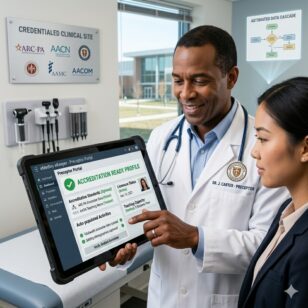
For clinical administrators in health science education, the preceptor recruitment phase is often a bottleneck of manual data entry and disconnected workflows. Digital transformation can solve two specific problems simultaneously: expediting the onboarding of new clinical sites and ensuring granular compliance with accreditation standards, such as those set by ARC-PA, AACN, AAMC, AACOM, and others.
- Eliminating Manual Data Entry: Digital onboarding closes the gap between recruitment and scheduling by automatically creating system records from approved applications, removing the risk of transcription errors and redundant paperwork.
- Granular Compliance Tracking: The system captures high-resolution data required for accreditation—such as patient demographics, encounter types, and telehealth modalities—directly during the initial onboarding phase.
- Real-Time Network Visibility: Integrated reporting provides an instant dashboard view of the clinical network’s capacity, allowing coordinators to match student competency needs with specific site offerings like surgical management or age-specific care.
The Challenge: Bridging the Gap Between the Application Form and Database
A common friction point for clinical education teams is the “gap” between a preceptor agreeing to take students and that preceptor actually existing in the scheduling system. Traditionally, a potential preceptor might fill out a paper or PDF form containing vital information—licensure status, board certification, practice setting, and student capacity. An administrator then has to manually verify this information and re-type it into the management software.
This manual transcription is not only time-consuming but introduces the risk of data entry errors. Furthermore, as accreditation standards evolve, programs are required to track increasingly specific data points regarding students’ exposure to patient populations, encounter types, experience requirements with credentialed preceptors, etc.
The Solution: The Integrated Preceptor Application in eKeeper
eMedley recently deployed a robust Preceptor Application module within eKeeper designed to digitize and automate this specific workflow. By analyzing the requirements of a leading Physician Assistant program, the platform was enhanced to support a seamless approval pipeline.
- Automated Record Creation
The core of this customization is automation. When a preceptor fills out the digital application, the data does not sit in a static file. Upon administrative approval of the application, a formal Preceptor record is automatically created within eMedley. This feature eliminates double-entry, allowing administrators to assign a Clinical Site based on the form data immediately. - Granular Data Capture for Accreditation
To meet rigorous standards, the application form was built to capture high-resolution data regarding the practice environment. The digital form now ingests specific fields including:
- Practice Demographics: Detailed breakdowns of patient populations (e.g., Prenatal, Infant, Adolescent, Elderly, Behavioral/Mental Health).
- Encounter Types: Categorization of care types such as Acute, Chronic, Emergent, Preventive, and Gynecologic Care.
- Capacity Planning: Specific fields for “Students per rotation” and “Students per year,” allowing clinical coordinators to forecast capacity accurately.
- Setting Types: Including modern care modalities like “Telehealth,” ensuring the program tracks diverse learning environments.
- Enhanced Reporting Capabilities
Data is only useful if it is accessible. Alongside the application tool, the eMedley implementation included a “Preceptor Clinical Summary” report. This report aggregates the data collected during the application process, providing administrators with a dashboard view of:
- Preceptor and Clinical Site associations.
- Setting Types and Age Categories served.
- Surgical Management opportunities.
- Reason for Visit classifications.
The Result: A Smarter Clinical Network
By moving from static documents to a dynamic, integrated application, health science programs can ensure that every new preceptor added to their network enriches their data ecosystem.
The inclusion of fields such as “Preferred Method of Communication” and “Professional School Name” allows for better relationship management, while the detailed capturing of patient demographics ensures that students are being placed in rotations that meet their competency requirements.
This case study demonstrates the need for academic management platforms to evolve alongside the needs of health science educators. By automating the administrative busywork of preceptor onboarding, clinical administrators are freed to focus on what matters most: the quality of student education and the maintenance of accreditation standards.
Interested in seeing how eMedley can streamline your program’s administrative workflows? Schedule a demo today to explore our comprehensive suite of tools.


