Closing the Loop: How Automated Alignments Bridge the Gap Between Curriculum and Assessment
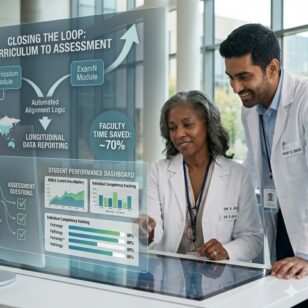
For clinical administrators and health science educators, the “curriculum map” is often the holy grail of program management. It promises a clear view of what is being taught, when it is being taught, and how students are performing against specific standards. However, the reality of maintaining this map often involves a significant administrative burden—specifically, the dreaded “double entry” of data.
Faculty members spend hours detailing session objectives, instructional methods, and accreditation standards (such as USMLE content outlines) within curriculum management systems. Then, when it comes time to create assessments, they are often asked to manually re-tag every individual exam question with those same attributes to generate meaningful reports.
This redundancy leads to faculty burnout, inconsistent tagging, and gaps in data.
A recent development within the eMedley platform—specifically bridging the eCurriculum and ExamN modules—demonstrates how intelligent automation can eliminate this bottleneck, transforming how programs track student performance without increasing faculty workload.
- Eliminating Redundant Data Entry: Automation removes the “double entry” bottleneck by allowing exam questions to automatically inherit metadata—such as objectives and accreditation standards—directly from the teaching session.
- The “Waterfall” Alignment Logic: By simply linking a question to a Session Objective, the system triggers a “waterfall” of data, instantly mapping the assessment to program goals, USMLE outlines, and specific instructional methods.
- Data-Driven Accreditation Readiness: This seamless integration creates “always-ready” longitudinal reports, providing students with granular performance feedback and administrators with consistent, real-time evidence for accreditation reviews.
The Challenge: Disconnected Data Points
In a standard educational workflow, a faculty member defines a teaching session in eCurriculum. This session is rich with metadata:
- Session Objectives and associated Program Objectives
- Discipline and Topic
- Instructional Methods
- USMLE Content Outlines
- Responsible Faculty
Later, that faculty member creates an exam in ExamN to assess the knowledge delivered in that session.
The challenge arose from a simple question: If the system already knows what was taught in the session, why must the faculty member manually realign the test question to all those same standards?
Asking faculty to make dozens of alignments at the exam level—when they have already done this work at the session level—is inefficient. Yet, without these alignments, administrators cannot run grade reports that indicate individual student scores in specific areas or gauge overall program effectiveness.
The Solution: Session-Based Inheritance
To solve this, eMedley implemented customized “Session Tree” logic that fundamentally changes how assessment data is captured.
Instead of requiring granular tagging for every question, the system was configured to allow questions to be aligned simply to the Session where the material was taught. Once a question is linked to a specific Session Objective in eCurriculum, an automated nightly process triggers a “waterfall” of alignments.
The question automatically inherits the DNA of the session:
- Curriculum Standards: The question is automatically mapped to the Program Objectives, Disciplines, and USMLE content outlines previously associated with the session.
- Pedagogy Tracking: The system aligns the question to the Instructional Methods used, allowing programs to see if students perform better on material taught via specific methods (e.g., Case-Based Learning vs. Lecture).
- Faculty Attribution: Questions are automatically aligned to the faculty member who taught the session, facilitating data on teaching effectiveness.
The Impact: Longitudinal Data and Accreditation Readiness
This automation moves beyond simple time-saving; it unlocks the full potential of longitudinal reporting.
Because the data flows seamlessly from the curriculum map to the assessment tool, eMedley can generate robust performance dashboards for both students and administrators.
For Students:
The implementation includes a student dashboard that visualizes performance in a longitudinal fashion. Students don’t just see a grade of 85%; they see their strengths and weaknesses broken down by topic, discipline, and USMLE content area. This feedback loop helps them identify exactly where to focus their study efforts.
For Administrators:
Program directors can run aggregate reports to gauge program effectiveness without manual data scrubbing. Because the alignment is automated, the data is consistent. If a session is tagged with a specific competency, every question linked to that session contributes to the assessment of that competency. This creates an “always-ready” state for accreditation reviews, providing evidence of how assessment links back to required standards.
Conclusion
The goal of educational technology should be to reduce friction, not create it. By automating the logic between eCurriculum and ExamN, eMedley ensures that the hard work faculty put into designing their courses pays dividends in the assessment phase.
This efficient approach to question alignment represents a significant step forward in health science education management, proving that with the right integration, you can have deep data insights without the administrative heavy lifting.
Interested in seeing how eMedley can streamline your program’s administrative workflows? Schedule a demo today to explore our comprehensive suite of tools.
